
At Cliftwood Animal Hospital, we offer advanced canine reproductive services in Sandy Springs tailored to professional breeders. Dr. Pabbidi provides pre-breeding evaluations, precise fertility timing using progesterone testing, and a full range of insemination techniques, including artificial, transcervical (TCI), and surgical insemination. We also perform pregnancy diagnosis and C-sections.
He is certified in OFA examinations and collaborates with specialists for genetic testing to support optimal breeding outcomes.
Dr. Pabbidi is currently authoring a manuscript on optimizing surgical insemination timing using progesterone testing and brings extensive experience in teaching and peer-reviewed research.
For expert canine reproductive care, you’re in the right place.

Reproductive Services provided at Cliftwood Animal Hospital
- Breeding soundness evaluations
- Semen analysis
- Semen freezing
- Artificial Insemination
- Trans-cervical insemination (Dr. Pabbidi is trained and certified)
- Surgical insemination
- Handling Fresh chilled semen
- Pregnancy Diagnosis using Ultrasound
- Puppy Count using X ray
- Infertility workups
- C-sections
- Whelping consultations
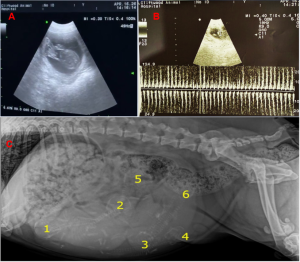
At Cliftwood Animal Hospital, we use both ultrasound and X-ray to offer a complete picture of your pet’s reproductive status. Dr. Pabbidi will guide you on the appropriate timing for each and explain how the results fit into your overall breeding plan.
A. Ultrasound – Gestational sac and puppy head visible. The image on the left is an ultrasound examination of a dog that underwent two Transcervical Insemination procedures revealed the presence of a gestational sac along with a clearly visible puppy head, confirming pregnancy.
B. Ultrasound –Fetal heartbeat tracing. The image on the right is the fetal heart rate that was measured using ultrasound in the same dog. On the image, the waveform at the bottom represents the heartbeat. Each deflection above and below the baseline corresponds to a single heartbeat.Counting these deflections allows accurate calculation of the fetal heart rate.
C. X rays – Fetal count. X ray performed after 46 days into gestation, puppy skeleton and heads are seen. Puppy count is obtained using abdominal X ray.
Monitoring fetal heart rate is critical for assessing puppy health and estimating timing of delivery. A fetal heartrate below approximately 150–170 beats per minute is concerning and may indicate fetal distress, oftensignaling that delivery is imminent. This parameter, along with other clinical findings, is used to help determinethe optimal timing for a cesarean section.
In this case, the dog is approximately 6 weeks pregnant, and the fetal heart rate is around 200-220 beats per minute, which is within a normal and healthy range for this stage of gestation.
When used together, these tools provide critical insights at every stage of the reproductive journey. Trust Cliftwood Animal Hospital for clear answers, accurate timing, and compassionate care for both mom and puppies.
Semen Freezing: Previous Doctor Dr. Kestle has been freezing semen with Zoetis since 1992 at Cliftwood Animal Hospital and Dr. Pabbidi who is the current owner and veterinarian mastered this technique and continued these services including semen collection, analysis and semen freezing. Our largest litters have always been from surgical inseminations performed with frozen semen at the right time.
Contract
The contracts below must be completed for each dog having semen frozen and stored at Cliftwood Animal Hospital for the first time or if a client is transferring frozen semen to Cliftwood Animal Hospital from another location.
*Seven days’ notice is required to ship/transfer any frozen semen. If you do not provide adequate notice, fee will be added to any and all bills.
Canine Surgical Insemination FAQs
What is canine surgical insemination?
An abdominal incision is made after the patient has undergone anesthesia and aseptic preparation. Once the uterus is located, semen is directly injected into an anterior horn of the uterus using a small needle.
Why is canine surgical insemination a useful procedure?
Breeding is most successful when semen can be placed in the anterior of the uterus at exactly the right time. This is especially useful when semen quality is low, when the female has fertility issues related to the cervix, and when using low-dose frozen semen.
What are the benefits of canine surgical insemination?
Semen must traverse the cervix to enter the uterus for fertilization to occur in natural breeding. With surgical insemination, the semen is exposed directly to the developing egg. This method has an excellent success rate, especially among sub-fertile females and instances where the semen’s quality is questionable.
Does my bitch need any testing before insemination?
Only a single breeding is typically performed using surgical insemination due to the cost and time involved. To maximize litter sizes and conception rates, ovulation timing is crucial. We always recommend a comprehensive pre-surgical exam and pre-anesthetic laboratory screenings before surgery.
Is there any other way to use frozen semen if I don’t want my bitch to undergo anesthesia?
Transcervical insemination also allows for intrauterine deposition of semen. However, surgical insemination is still recommended in circumstances with poor semen or a female with known cervix issues. Surgical insemination is the recommended and preferred technique for frozen semen.